Junior Keeper, chapter 1 of 3
Chapter 1: A Day in the Life of a Keeper
My first duty to you as keeper is to explain what a lighthouse is and what the parts are called.
A dictionary will tell you that a lighthouse is a tower with a powerful light at the top, built at a place that is important or dangerous for ships, to guide or warn them at night. That is right, as far as it goes. A dictionary does not tell you who carried the oil up the stairs.
That was me.
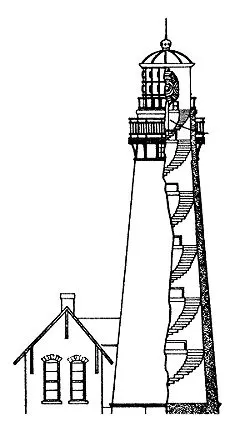
This is a picture of my lighthouse. It is more than 90 feet tall, painted white and built of bricks, hundreds of thousands of them. Inside is a spiral staircase of 114 steps. I know the number because I counted them every evening on the way up and every morning on the way down.
Sunset to sunrise
A keeper's day is really a keeper's night. Here is how mine went.
About half an hour before sunset I climbed to the lantern room with a can of oil. I filled the lamp, trimmed the wicks so they would burn clean and lit them. Then I pulled back the curtains. Yes, curtains. During the day the lens is covered, because a lens that can throw light twenty miles out to sea can also gather sunlight and start a fire.
Next I wound the clockwork. A heavy weight hung on a cable inside the tower, and as it slowly dropped it turned the lens, just as the weights in a grandfather clock turn the hands. Every couple of hours it reached the bottom and had to be cranked back up. If I fell asleep, the lens stopped, and a light that has stopped flashing looks to a sailor like a different lighthouse. So keepers did not fall asleep.
All night we took turns on watch. One keeper stayed with the light while the others slept, and then we changed over. In fog we started the fog signal too, and nobody slept much at all.
At sunrise I put out the lamp, closed the curtains and began cleaning. Soot from the lamp settles on glass. Salt spray dries on the windows. Brass turns dull if you look away from it. An inspector could arrive without warning, and he was known to run a white glove along the shelves.
After that came breakfast, and after breakfast came painting, mending, gardening and writing up the logbook. Then a nap, and then it was nearly sunset again.
Lighthouse lingo
Read each term, then find the part on the drawing.
- Lantern room: the glass room at the very top that holds the lamp and lens
- Fresnel lens (say it fre-NEL): rings of glass prisms that gather the lamp's light and bend it into a beam. Lenses come in sizes called orders. First order is the largest, taller than a grown man
- Gallery: the narrow balcony around the outside of the lantern room, where the keeper stood to clean the windows
- Watch room: the room just below the lantern, where the keeper on duty sat through the night
- Focal plane: how high the middle of the light is above the sea. The higher it is, the farther away it can be seen
- Oil house: a small building set apart from the others, where the lamp fuel was stored in case of fire
- Keeper's quarters: the house where the keeper's family lived
- Fog signal: a horn, bell, whistle or siren sounded when fog hid the light
- Signature: the pattern of flashes that belongs to one lighthouse and no other
- Tender: the supply ship that brought oil, paint, food and mail to the station
- Logbook: the daily record every keeper had to write, with the weather, the work done and anything unusual
Try it
Stand at the bottom of a staircase at home or at school. Count the steps. Now work out how many times you would have to climb it to reach 114. That was one trip to my lantern room, and on a busy night I made four or five.
When you have matched every word to the drawing, go on to Chapter 2: A Little Lighthouse History.