Newport, Oregon44°37.4′N 124°03.8′W
Yaquina Bay Lighthouse
Lit 1871 to 1874, relit 1996F W · 161 ft · 6 M
Its signature tonightA steady white light, shown every night since December 7, 1996.
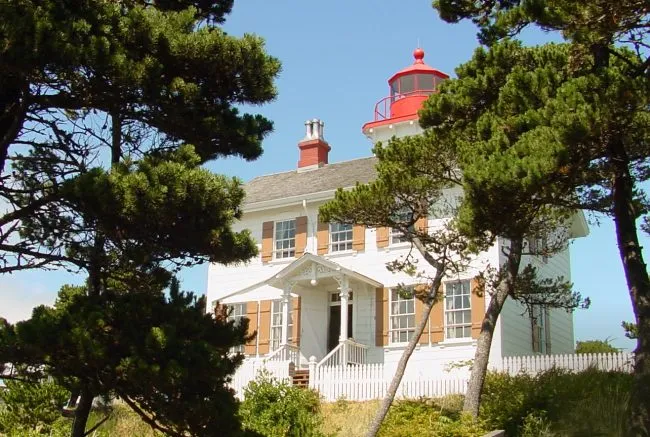
Charles Peirce moved into this house in the autumn of 1871 with his wife Sarah and their children, and the following March a daughter, Kate, was born upstairs. She was the ninth. Less than three years after the family arrived, Peirce climbed to the lantern, put out the lamp on government orders and packed for a new post at Cape Blanco.
That short working life, November 3, 1871 to October 1, 1874, is the shortest of any Oregon lighthouse. The building has now spent fifty times as long doing other things, and for a while nothing at all.
A light for a boom town
Newport in 1871 was brand new and Yaquina Bay was the busiest harbor between San Francisco and Puget Sound. Oregon's legislature had petitioned the Senate for a light at the entrance in 1869. In April 1871 the government paid Lester and Sophrina Baldwin $500 in gold for thirty-six acres on the bluff north of the channel, and work began on the first of May.
Ben Simpson of Newport built the house, a plain two-story frame dwelling with a square lantern tower rising through the roof. Joseph Bien of San Francisco supplied the iron lantern. A fifth order Fresnel lens, the only one of that small size among Oregon's coastal lights, showed a steady white light 161 feet above the water.
It was a harbor light, meant to bring ships to the bar. For the coast itself the Lighthouse Board had bigger plans, and those plans were already under way three miles north, where the tall brick tower at Yaquina Head was lit in August 1873. Within fourteen months the little light at the bay was judged unnecessary. Its lens was sent to California for a new station on Yerba Buena Island in San Francisco Bay.
The house nobody wanted
An attempt to sell the building in 1877 failed because the offers were too low. In 1878 the government paid for a new roof and siding simply to keep the place from falling down.
From 1888 to 1896 the Army Corps of Engineers used it as quarters while the jetties at the bay mouth were built. John Polhemus, the engineer in charge, was living here with his family on the morning in November 1889 when lightning hit the building.
A severe thunder storm occurred here this morning accompanied by some hail. Lightning struck the old lighthouse building occupied by J. S. Polhemus, government engineer. The building was badly splintered and the furniture demolished. Mrs. Polhemus and child narrowly escaped.
In 1906 the Life-Saving Service moved a crew in. Its successor, the Coast Guard, put up a steel lookout tower beside the house, which is still there, and stayed until 1933. Then the doors were locked again.
The ghost that was invented in 1899
Any empty house on a bluff gets a ghost, and this one has a named author. In 1899 Lischen M. Miller published a short story called "The Haunted Lighthouse" in the Pacific Monthly. In it a girl named Muriel Trevenard goes back into the abandoned building to fetch a handkerchief and is never seen again, leaving only bloodstains behind. It is fiction from start to finish. It has been retold as fact for more than a century, and guides at the house are still asked which room it happened in.
Saved twice
The state acquired the bluff in 1934 for a park and by the late 1940s intended to pull the derelict lighthouse down. The Lincoln County Historical Society was formed in 1948 largely to stop that. Demolition was scheduled again in 1951. L. E. Warford, an Ohio industrialist who had grown up in Oregon, took up the cause and campaigned for national recognition, and by 1955 the wrecking plans were dropped. The building was dedicated as a historic site in 1956 and served as the county museum for eighteen years.
In 1974 Oregon State Parks began a year-long restoration, and the lighthouse was entered on the National Register of Historic Places. The Friends of Yaquina Lighthouses, formed in 1988, have supplied the volunteers ever since.
On December 7, 1996, the lantern was lit again. The lighthouse historian James Gibbs, who provided the 250 mm optic, threw the switch. The light is steady white, can be seen about six miles, and is listed by the Coast Guard as a privately maintained aid to navigation.
The most recent chapter was a major repair job. The lighthouse closed at the start of 2025 for an exterior restoration costing about $1.8 million. Carpenters found more rot and crumbling brick than anyone expected. The cast-iron lantern, all 11,000 pounds of it, was taken off and shipped to a specialist metal shop in Alabama, and on August 12, 2025 a crane set it back on the roof.
Inside
Yaquina Bay is the only lighthouse left in Oregon where the keeper's whole household lived in the same building as the light. That is what makes the visit different from the others on the coast. You see where a family lived.
The rooms are furnished as they might have been in the 1870s. The dining room is small for a family of nine. Water came from a cistern by hand pump, and the cooking was done on a wood stove beside a pantry not much bigger than a cupboard. The basement, which now holds the shop and a video room, was the storeroom, and in wet weather the laundry was dried there.
A wooden staircase leads to the bedrooms. Fourteen more steps take you to the watch room, where the original iron ladder still goes up through the ceiling to the lantern. Visitors stop here.
Visiting
The lighthouse stands in Yaquina Bay State Recreation Site at the north end of the Yaquina Bay Bridge. Take the first turn off Highway 101 north of the bridge and follow the park road to the top of the bluff.
Even with the house closed the stop is worthwhile. The viewpoint looks straight down on the jetties and the bar, and on a rough day you can watch fishing boats time their run through the entrance. Stairs lead to the beach. The Coast Guard's steel lookout stands beside the lighthouse like a younger, plainer relative.
Go after dark at least once if you are staying in Newport. The lantern is lit from dusk, and seen from the bridge it looks exactly as a harbor light should.
Questions visitors ask
- Why was Yaquina Bay Lighthouse used for only three years?
- Because the much taller, brighter light at Yaquina Head came into service in 1873, three miles away. The Lighthouse Board decided one light could serve both the coast and the harbor, and the small one was switched off on October 1, 1874.
- Is Yaquina Bay Lighthouse really haunted?
- The famous ghost comes from a short story published in 1899. No keeper or resident died in the house in the way the story describes. Believe what you like, but Muriel Trevenard was made up.
- Is the original lens in the lantern?
- No. The fifth order lens went to California in the 1870s. The light you see comes from a small modern optic installed for the relighting in 1996.
- Can visitors go up into the lantern itself?
- No. The public route ends in the watch room, one level below. The last climb is by a narrow iron ladder through a hatch, and it is kept for the people who maintain the light.