Florence, Oregon44°08.3′N 124°07.7′W
Heceta Head Lighthouse
ActiveFl W 10s · 205 ft · 21 M
Its signature tonightOne white flash every ten seconds, the pattern since the lens was speeded up in 1934.
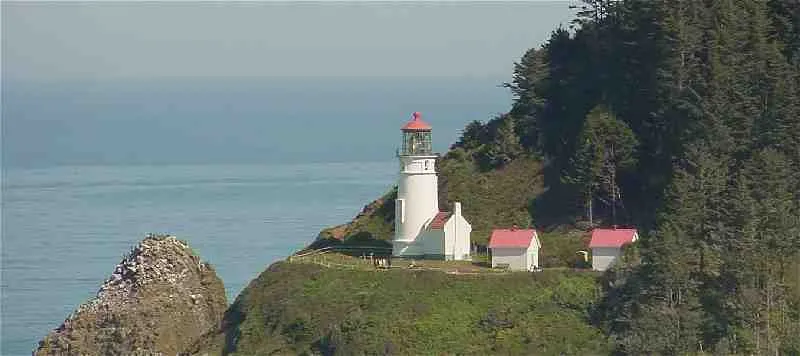
The keeper's job at Heceta Head came with a five-hour wagon ride to the nearest town and, in Andrew Hald's case, the death of a baby daughter for want of a doctor. Hald was the first head keeper. He reached the station in 1894 by train, coastal steamer and a 24-mile walk along the beach.
Today Highway 101 runs past the gate and this is the most photographed lighthouse in Oregon. The isolation is hard to picture until you stand on the trail above the cove with your back to the road. Then it comes back quickly.
A gap ninety miles wide
In 1888 the Lighthouse Board pointed out that ships had ninety miles of unlit coast between Yaquina Head and Cape Arago, and asked for two first order lights to fill it. One went to the Umpqua River. The other went here. Congress appropriated $80,000 on March 2, 1889.
The headland takes its name from Bruno de Heceta, a Basque-born officer of the Spanish navy who sailed past in 1775 and noted the shallow water offshore. Long before him it was Siuslaw country. The people of the lower river hunted sea lions and gathered seabird eggs along these cliffs.
Building on a shelf
The site was a ledge cut into the hillside about 150 feet above the sea, with a second bench lower down for the houses. Contracts were signed in late 1891: $13,700 for the tower, $5,000 for its ironwork and $20,470 for the dwellings, barn and oil houses.
Lumber came from local mills. Brick and cement came by sea from San Francisco, and the stone for the base was quarried on the Clackamas River near Oregon City. Materials were landed when weather and tide allowed, or hauled up from Florence by wagon. Laborers got two dollars for a ten-hour day. The best carpenter got four.
The houses were finished in January 1893. A landslide held up the tower until August. The lens arrived in October, and then everyone waited five months for the lamp, which had been delayed at the lighthouse depot on Staten Island. The light was shown for the first time on March 30, 1894.
The tower was built from the same drawings as the one at Umpqua River, and the two are close to identical.
An English lens
Nearly every big lens in an American lighthouse was made in Paris. This one came from Chance Brothers of Birmingham, England. It has eight bullseye panels and 640 prisms, each about two inches thick, and its beam, visible 21 nautical miles out, is rated the strongest on the Oregon coast.
In the oil-lamp years the lens turned slowly and a ship saw one flash a minute. The works were driven by a weight on a cable, in the manner of a tall clock, and the keeper on watch wound it back up by hand through the night. Electricity arrived in 1934. A 500-watt bulb made the light more than five times as bright, and an electric motor turned the lens fast enough to give a flash every ten seconds.
Three families and a schoolhouse
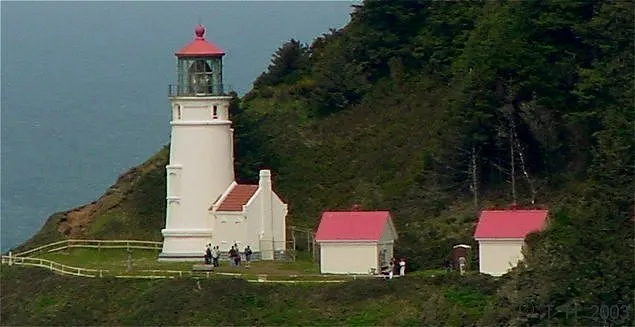
The station was built for three keepers. The head keeper had a house of his own and the two assistants shared a duplex next door. Even the lamps indoors followed rank: when electric fixtures went in, the head keeper's had six bulbs, the first assistant's five and the second assistant's four. With three families on the bench there were enough children to justify a one-room school, and one was built.
Olaf Hansen came as first assistant in 1896 and was head keeper from 1904 to 1920. Clifford Hermann held the post for the next quarter century, from 1925 to 1950. In 1927 he and an assistant, Charles Walters, rescued a man who had fallen from the cliff at Sea Lion Caves. Hermann retired after 49 years in the lighthouse service.
The second assistant's position was abolished in the late 1930s and the head keeper's house was sold for scrap lumber in 1940. Its boards went into a café in Mapleton. During the Second World War as many as 75 Coast Guardsmen were quartered on the site, patrolling the beaches day and night with about a dozen dogs.
The night the lens was turned by hand
Oswald Allik arrived as head keeper in 1957, straight from closing the light on Tillamook Rock. On February 12, 1961, a storm brought a rockslide down on the power line. The backup generator failed too. Allik and two Coast Guard assistants lit an Aladdin lamp inside the lens and pushed the whole apparatus around by hand from midnight until half past seven in the morning.
Two years later the light was automated, and Allik became the last keeper of a second Oregon lighthouse.
The lens has stopped only a few times since. It was out from June 2000 to March 2001 for repairs to its turning gear, and for three months in 2009 when the brass wheels it rides on needed attention. From August 2011 to June 2013 the tower was closed for a $1.3 million restoration, which stripped off cement stucco that had been trapping damp, repaired the ironwork and masonry and put in new windows. In the spring of 2026 the turning mechanism failed again and the lantern went dark while repairs were arranged.
The house below
The surviving duplex, known as Heceta House, was leased to Lane Community College for field classes after the keepers left and has been a bed and breakfast since 1995. It stands on Forest Service land. It also has the best-known ghost on the Oregon coast, a spirit the residents call Rue. The stories about her are affectionate. She is said to tidy up.
Visiting
The entrance is on Highway 101 about twelve miles north of Florence, just south of the Cape Creek tunnel. The parking lot sits at beach level under Conde McCullough's Cape Creek Bridge of 1932, a tiered concrete viaduct that would be a destination anywhere else.
From there a wide gravel track climbs half a mile, past the keepers' house and through spruce, to the tower. Anyone reasonably fit can do it in fifteen minutes. When volunteers are on duty they will let you into the ground floor and talk you through the building. The staircase to the lens is closed.
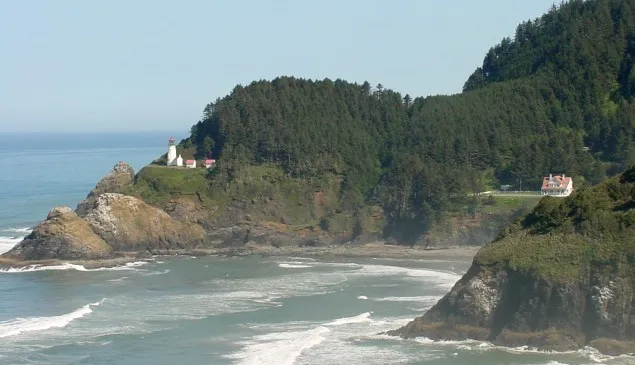
For the picture on every postcard, drive a mile south on 101 to the pullouts near Sea Lion Caves and look back north. The lighthouse and the red roofs of the house line up on the headland with the cove below. Late afternoon gives the best light. In winter and spring watch the water as well, because gray whales pass close to the head.
Questions visitors ask
- Can you go to the top of Heceta Head Lighthouse?
- Not currently. The spiral stairs and lantern have been closed to visitors for several years, and guided visits, when volunteers are available, cover the ground floor and the grounds. The view of the lens from outside at dusk is still worth the walk.
- Is the Heceta Head light working?
- It is an active aid to navigation, but in spring 2026 the mechanism that turns the lens broke down and the light was switched off pending repair. Ask Oregon State Parks for the present position before planning a night visit.
- Can you stay overnight at the lighthouse?
- You can stay in the assistant keepers' house below the tower, which operates as a bed and breakfast under a Forest Service permit. Bookings are handled by the inn itself, not by the park or by this guide.
- How do you pronounce Heceta?
- Most Oregonians say "heh-SEE-tuh". The Spanish original, with a silent H and the stress on the second syllable, is closer to "eh-THEH-ta".