Bandon, Oregon43°07.4′N 124°25.4′W
Coquille River LighthouseBandon Light
Dark since 1939, open in seasonOc W 30s · 47 ft · 12 M (to 1939)
Its signature, as it wasTwenty-eight seconds of steady white light, then a two-second eclipse. Shown from 1896 to 1939.
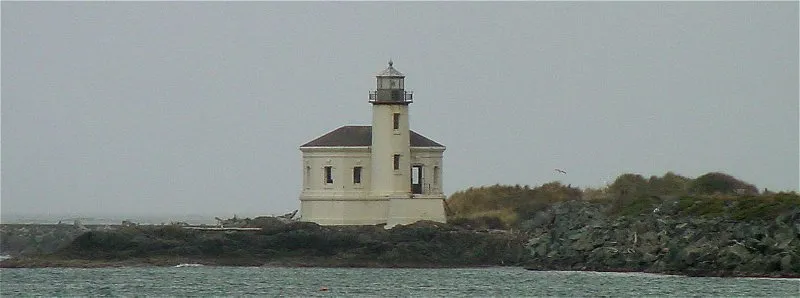
The Coquille River Lighthouse was first lit on February 29, 1896, which means it has had a true anniversary only once every four years. On March 1, its second day, a snowstorm came in off the sea and the keepers ran the fog trumpet for the first time.
It was the last lighthouse built on the Oregon coast and one of the smallest. It also has the oddest shape: a short round tower joined to a low eight-sided room, the whole thing standing by itself where the river meets the jetty, with the old town of Bandon directly across the water.
Why Bandon needed it
The Coquille is a small river with a bad bar. Sand shifts across its mouth from one season to the next, and in the 1890s schooners carrying lumber, coal and farm produce crossed it constantly. Congress appropriated $50,000 on March 3, 1891. Building did not start for another four years.
Workmen and materials arrived in April 1895. They leveled the top of an outcrop called Rackliff Rock on the north side of the entrance and built on that, in brick covered with stucco. The keepers' house, a duplex with three bedrooms on each side, stood 650 feet back among the dunes and was joined to the tower by a plank walkway. Each family had a 15,000-gallon brick cistern. A barn stood beyond the house.
Light and trumpet
The lens was a fourth order Fresnel, a modest size suited to a harbor entrance. Its lamp burned steadily and a mechanical screen cut the light off for two seconds in every thirty. Out of the seaward wall of the signal room pointed the horn of a Daboll trumpet, sounding a five-second blast every thirty seconds in thick weather.
On a coast with this much fog the trumpet mattered at least as much as the lamp. In 1924 an electric fog bell was added at the end of the south jetty.
Keepers
James F. Barker was the first head keeper, with John M. Cowan as his assistant. Both men came down from Heceta Head. The post changed hands several times in the first ten years, and then two men covered the rest of the station's life between them: Oscar Wiren from 1906 to 1921, and Oscar Langlois from 1921 until the light was put out. Langlois had come to the Coquille as an assistant in 1910, having started in the service at Cape Arago in 1905. Among the assistants on the rolls is a Marie Langlois.
The entrance kept them busy. In the first years of the 1900s the schooner C. A. Klose tried to come in over a very rough bar in light wind and ended up on the rocks right in front of the lighthouse, close to ramming it. The tug Triumph hauled her off and nobody was badly hurt.
The fire of 1936
In late September 1936 a forest fire, driven by an east wind through hillsides of oily gorse, came down on Bandon and burned it flat. Of roughly five hundred buildings, sixteen were left. The Coast Guard lifeboat station on the south bank was destroyed.
The lighthouse had the river between it and the fire. Ash and soot covered everything, but nothing burned. The lighthouse tender Rose ferried patients from the town's hospital across to the north side, and people who had lost their homes sheltered at the station. Langlois and his assistant Charles Walters were both commended for what they did that week.
Bandon's shipping trade never came back. Three years later the Coast Guard, which had just absorbed the Lighthouse Service, decided that an automatic light on the south jetty was all the entrance needed. The lens and the trumpet were taken out, the keepers' house was dismantled, and the lighthouse was left to the weather.
Twenty-four years of nothing
From 1939 to the early 1960s the building had no owner who cared about it. It was vandalized and left open to the weather. What saved it was the creation of Bullards Beach State Park, which took in the north spit and the lighthouse with it.
A joint project of the state and the Army Corps of Engineers began in 1976, and the building reopened in 1979. In 1991, for Bandon's centennial, a small solar-powered light was placed in the lantern. It is a decoration and has no navigational purpose, but it means the tower is no longer dark at night.
2007 and the argument about red
By the 2000s the stucco was failing again. A restoration in the summer of 2007, costing more than $600,000, took off the damaged render, replaced the roof, repaired the copper flashing, added a replica chimney and repainted the whole exterior. The work is followed stage by stage on the 2007 renovation page, an earlier set of pictures is in the 2003 gallery, and the planning is covered in Coquille River restoration news.
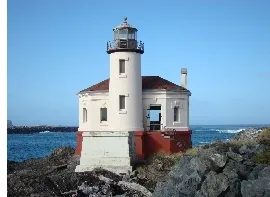
When the painters stripped the old coats they found a layer of red low on the walls, and the base was repainted red to match. That started an argument that has not been settled. The official light lists describe the building as white, and for at least one year as cement colored. Old black and white photographs show the base darker than the tower in some views and the same in others, and none of them is dated. Nobody has yet shown when the red went on, or whether it was the first coat.
Visiting
Bullards Beach State Park is on Highway 101 two miles north of Bandon, immediately north of the river bridge. Turn in, pass the campground and follow the park road for about three miles along the spit until it ends at the lighthouse.
The drive is half the pleasure. The road runs between the Coquille estuary on one side, with cormorants, pelicans and geese around the Bandon Marsh refuge, and a line of dunes on the other. The lighthouse stays hidden until the last bend.
When hosts are on duty you can go into the signal room, which has displays on the keepers and the bar, and look up into the tower. The stairs are closed. Outside, walk onto the jetty for the view back at the building with Bandon behind it, and expect wind.
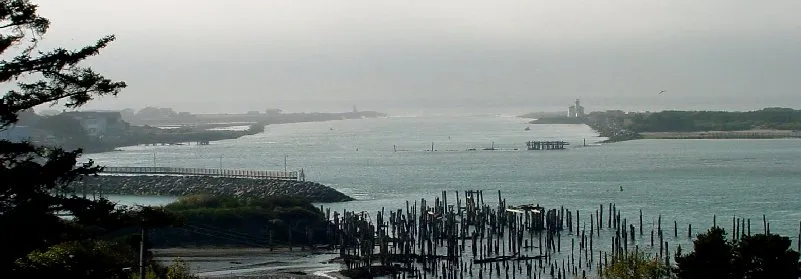
For the opposite view, go into Bandon's Old Town and stand on the waterfront or at the south jetty. From there the lighthouse sits low on the far side of the channel, exactly as incoming schooner captains saw it.
Questions visitors ask
- Can you climb the tower at Coquille River Lighthouse?
- Not at present. The stairs need structural repair and the lantern is closed. In season, volunteers open the fog-signal room at the base.
- Is the Bandon lighthouse still a working light?
- No. It was decommissioned in 1939 and the entrance is marked by lights on the jetties. The small solar lamp placed in the lantern in 1991 is ornamental.
- Do you have to pay to drive out to the lighthouse?
- The lighthouse is inside Bullards Beach State Park. Oregon has been extending day-use parking fees to more parks, so check the park's page for the current rule.
- Why is the lighthouse on the north side when the town is on the south?
- The rock was on the north side. Rackliff Rock gave the builders a solid foundation right beside the channel, which the sand of the south bank could not.