Oceanside, Oregon45°29.2′N 123°58.7′W
Cape Meares Lighthouse
Dark since 1963, open in seasonF W, Fl R 60s · 217 ft · 21 M (to 1963)
Its signature, as it wasA steady white light with one red flash every minute, shown from 1890 until the lens was retired in 1963.
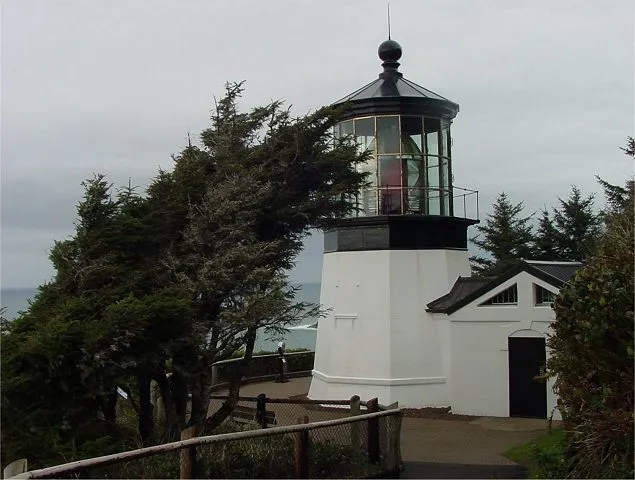
You walk downhill to this lighthouse. The path leaves the parking lot, drops through wind-bent spruce for a few hundred yards, and at the bottom the tower appears below eye level, so short that the lantern is the first thing you meet. Cape Meares Lighthouse is 38 feet tall. The cliff under it does the rest of the work, putting the light more than 200 feet above the sea.
A cape with a borrowed name
In 1788 the English trader John Meares gave the name Cape Lookout to this headland. Chartmakers in the 1850s put the name on a different cape ten miles south, the mistake stuck, and in 1857 George Davidson of the Coast Survey solved the problem by renaming the original cape after Meares.
That muddle fed a long-lived rumor that the lighthouse was built on the wrong cape. The surveys say otherwise. Both capes were examined in 1886, and the engineer's report preferred Cape Meares because materials could be brought in through Tillamook Bay.
Iron plates and a crane made of spruce
Congress approved $60,000 in 1886. Three contracts were let in August 1888: $26,000 to Richard Leaman of Portland for two keepers' houses, two oil houses, a barn and a cistern; $7,800 to Willamette Iron Works for the metalwork; and $2,900 to Charles Duhrkoop of Seattle to put the tower up.
The tower is an octagon of sheet iron lined with brick, standing on a ledge cut into the rock. Nothing else like it was built on the Oregon coast. The lens was made by Henry-Lepaute in Paris, shipped around Cape Horn and lifted up the cliff in crates by a hand-worked crane built on the spot from spruce logs. Everything was in place by December 23, 1889, and keeper Anthony W. Miller showed the light for the first time on New Year's night, 1890.
The lens
A first order Fresnel lens is about the size of a garden shed and weighs around a ton. This one has eight sides. Four are plain panels that send out a steady white light. The other four carry bullseyes that were covered with ruby glass. The whole lens turned once every four minutes on brass wheels, so that a ship offshore saw fixed white light interrupted once a minute by a red flash.
A 200-pound weight on a cable drove the turning gear, and somebody had to crank it back up about every two hours, all night, every night.
The long walk to work
The keepers lived in two houses about a thousand feet up the hill, where the parking lot is now. A board walkway with handrails ran down to the tower. No other Oregon station had so long or so steep a walk between bed and lamp, and in a winter gale the rails were the only thing keeping a man upright.
The nearest doctor was in Tillamook, a rowboat trip across the bay that had to be timed to the tide. George Hunt, the second head keeper, served eleven years here. In July 1903 the station log recorded that he had pneumonia, and on July 10 it recorded his death at six in the evening. His wife Augusta kept the light in his place until a replacement arrived at the start of August. Her few weeks make her one of a small number of women who were in charge of an Oregon lighthouse.
In the early 1900s day-trippers from Bayocean, the resort town on the Tillamook Bay spit, made the hike to the lighthouse a standard outing. Bayocean itself was eaten by the sea over the following decades. Nothing of it remains.
Electricity reached the cape in 1934, and the oil houses came down.
Dark, robbed and shot
In 1963 the Coast Guard put an automated beacon on a concrete blockhouse beside the old tower and locked the lighthouse. The last keeper, David A. Duncan, mailed off the station records and reported the place unmanned. The Coast Guard meant to pull the tower down. Local people objected, Tillamook County took a lease in 1964, and Oregon State Parks took over in 1968.
By then the damage was done. With nobody living on the cape, vandals had wrecked the keepers' houses, which were later razed, and thieves had carried off all four bullseyes from the lens.
They came back one at a time. Police found one during a drug raid in Portland in 1984. In 1986 a magazine article asked for the others, no questions asked. One was handed in at the county museum in Tillamook. Another turned up wedged between the front door and the storm door of an assistant park manager's house at Cape Lookout on a very wet day. The last surfaced years afterward.
The lighthouse opened to visitors on Memorial Day 1980 with a replica workroom on its east side. Then, on the night of January 9, 2010, two young men from Oceanside drove down the closed road and fired at the lantern. They broke fifteen windows and several prisms. The damage was put at half a million dollars. Both were caught within a month, pleaded guilty, were ordered to pay $100,000 and spent parts of three winters in jail.
The Coast Guard switched off the modern beacon on June 25, 2014, saying that satellite navigation had made it unnecessary. After 124 years the cape is unlit.
Visiting the cape
Cape Meares is the northern end of the Three Capes Scenic Route. From Tillamook, follow the signs west toward Oceanside and Netarts and then north to the viewpoint, about ten miles in all.
Give the cape more time than the lighthouse alone needs. A short trail in the other direction from the parking lot leads to the Octopus Tree, a Sitka spruce with no central trunk and half a dozen limbs that rise like a candelabrum. The viewing decks along the lighthouse path look across to Three Arch Rocks, where murres and puffins nest and sea lions bark from the ledges, and gray whales pass close in during the winter and spring migrations. Peregrine falcons hunt along the cliff.
When the tower is open, volunteers take a few people at a time up the stairs to stand beside the lens. You can see the bullet damage and the mends. The path is paved, and the way back to the car is uphill all the way.
Questions visitors ask
- Why does the light at Cape Meares no longer shine at all?
- The historic lens was retired in 1963 and the automated beacon that replaced it was disconnected in 2014. The Coast Guard judged that ships along this stretch no longer needed it. The lighthouse is now kept purely as a historic site.
- Is the lens at Cape Meares complete again after the theft and the shooting?
- The stolen bullseyes were recovered, but the lens still shows its scars, including damage from the gunfire in 2010. It is on view, and it is not lit.
- How long is the walk from the parking lot to the lighthouse?
- Roughly two tenths of a mile each way on a paved path. The return leg climbs steadily. Most people take ten minutes down and a little longer back.
- Is there a fee to visit Cape Meares?
- Policies on day-use fees in Oregon state parks have been changing, so look at the park's own page before you go. The lighthouse itself has traditionally been free to enter, with donations welcome at the gift shop.