Report, 2006
Cape Arago Lighthouse in the news
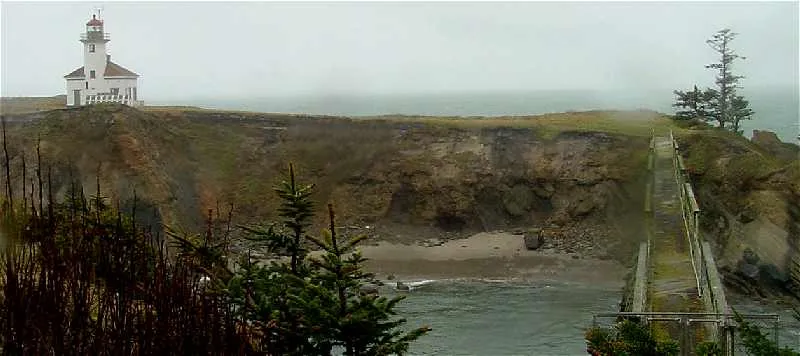
The Coast Guard decommissioned the Cape Arago light on January 1, 2006, after posting a notice to mariners the previous September. The 30-day comment period brought hardly a word from sailors or fishermen that the light still served them. The World News of Coos Bay reported on February 2, 2006 that the beacon, which had winked on and off for 140 years, did not have to stay dark forever if local support appeared.
A light from another age
Electronics in the wheelhouse now give vessels more accurate navigation and safety data than a light on an offshore rock, and local mariners called the old light antiquated. Even so, it was of real interest to the community. The Coos County Historical Society called it important and significant to local history.
Tribal interest
The Confederated Tribes of the Coos, Lower Umpqua and Siuslaw Indians were interested not so much in the lighthouse as in the land, Chief's Island and the adjacent Gregory Point, long a traditional place of reverence. The Coast Guard had a small housing facility on Gregory Point that had stood vacant for years after a tree fell on its roof, and vandals and weather had hurt the buildings. The property seemed likely to go through the U.S. General Services Administration.
The tribes had asked the federal government years before about getting the land back, when the plan was a large interpretive center. In the meantime they worked with the Coast Guard to reach the property and keep up the grounds, mowing grass, cutting brush and tending the tribal cemetery on the southern edge. They also hold an annual salmon ceremony at the site. Tribal leaders described a scaled-back plan for the 19 acres, a cultural facility, modeled on the way they had acquired the Coos Head property near Bastendorff Beach. Gregory Point holds a tribal cemetery, archaeological finds and shell middens left by ancestors.
Other paths for a decommissioned light
The head of the U.S. Lighthouse Society explained that the National Historic Lighthouse Preservation Act sets an official process so that decommissioned lights go to qualified organizations. Some go to private owners, some to state or federal agencies, as Heceta Head went to Oregon State Parks. Private ownership risks losing public access, though many owners restore the lighthouse and quarters. Often there is a cooperative agreement between the Coast Guard and a local group.
For Cape Arago, no local support group had formed even while the light was lit. The Coast Guard planned to ship the rotating beacon and solar panels to Seattle as spares. The bridge between Gregory Point and Chief's Island was unsafe, so access was by boat, helicopter or a long walk at very low tide.
Other groups had raised money and restored lights farther offshore and in worse shape. The St. George Reef Lighthouse Preservation Society, working with Del Norte County and the National Park Service off the California border, was cited as an example, with its restored tower, onshore museum and helicopter tours. The lesson, the society's director said, was that a group has to organize first and show the government it is ready.
The lighthouse's history is on the Cape Arago Lighthouse page. For how lights are handled nationwide see who keeps Oregon's lighthouses.